The JFK 100
The First Shot
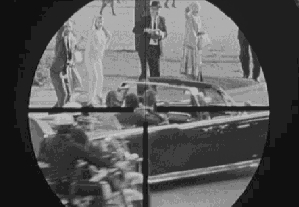
The President's limousine viewed from a lower floor in the Dal-Tex Building
The President's limousine viewed from a lower floor in the Dal-Tex Building
Stone's scenario begins:
The camera is on Kennedy waving. A MONTAGE follows -- all the faces in the square that we've introduced in the movie now appear one after the other . . . INTERCUT with the Zapruder and Nix films on JFK in the final seconds coming abreast of the Stemmons Freeway sign.With regard to the timing of the first shot, Oliver Stone is on solid ground. It is universally accepted that at least one shot missed the motorcade, and there is a great deal of evidence that such a shot missed at about frame 155 of the Zapruder film.
CUT TO: the Dal-Tex shooter firing. We see the back of Kennedy's head through his gun sight. Kennedy (stand in) reacts in the Zapruder film.JIM (VOICE OVER) The first shot rings out.
JIM (V. O.) Sounding like a backfire, it misses completely . . . Frame 161, Kennedy stops waving as he hears something. Connally turns his head slightly to the right.(1)
However, there is no evidence whatsoever of a shot from the Dal-Tex Building behind the limousine; following the assassination, not even a single witness reported hearing shots come from the building, much less seeing anyone fire a gun there.(2) Compare this to the witnesses who saw someone fire from the "sniper's nest" window of the Texas School Book Depository, as well as the many earwitnesses who immediately indicated the building as the source of the shots.
For example, Howard Leslie Brennan saw a gunman fire from the "sniper's nest" window, and later identified Lee Harvey Oswald as the gunman.(3)
15-year-old Amos Lee Euins saw someone fire from the window, though he could not positively identify the shooter as Oswald.(4)
James Robert Worrell, Jr., saw a rifle firing from the window.(3) Robert Hill Jackson of the Dallas Times Herald and newsreel photographer Malcolm O. Couch saw a rifle in the window immediately after the shots were fired, as did Dallas Mayor Earle Cabell and his wife.(3)
James N. Crawford and Mary Ann Mitchell each had their gaze attracted to the window during the shots and noticed movement in the window, which they both believed to have been a person.(7) Robert Fischer and Robert Edwin Edwards both noticed someone in the window shortly before the motorcade turned onto Houston Street from Main, though neither could positively identify the man as Oswald.(8)
Texas School Book Depository employees Harold Norman, Bonnie Ray Williams, and James Jarman, Jr., were looking out windows on the fifth floor, directly below the "sniper's nest" window; all three men were certain that shots came from directly above them.(9)
Dallas police officer Marrion L. Baker rushed into the building immediately after the shots were fired; his attention had been drawn, he would later testify, by a flock of pigeons that flew from the building's roof at the moment of the shots.(10)
Police Inspector J. Herbert Sawyer testified that after the shooting, he talked to "a number" of people who "were pointing out one of the upper floors of the Texas School Book Depository" as the source of the shots.(11)
Officer Welcome Eugene Barnett heard the shots and immediately believed they had come from the roof of the Book Depository. Numerous other witnesses believed the shots had come from the Depository building, based on the sound of the shots.(12) Two photographers in Dealey Plaza, Tom Dillard and James Powell, were independently motivated to snap photos of the south side of the Depository building, including the window later identified as that of the "sniper's nest."(13)
So the evidence supports Stone on the timing of the first shot, but not its place of origin.
NOTES:1. Oliver Stone and Zachary Sklar, JFK: The Book of the Film (New York: Applause, 1992), p. 164. All quotations are from the shooting script and may vary slightly from the finished motion picture.
2. This author is aware of only a single allegation ever being made about a witness reporting the sound of shots from the Dal-Tex Building in particular, and it could hardly be more erroneous. In Six Seconds in Dallas, Josiah Thompson claims that eyewitness F. Lee Mudd told the FBI that he "thought one or more of the shots came from the direction of the Dal-Tex Building." (Josiah Thompson, Six Seconds in Dallas [New York: Bernard Geis Associates, 1967], p. 132.)
Here's how Thompson quotes Mudd, with bracketed insertions and ellipse as in Thompson:
He looked around him [the FBI report relates], and he recalled that in looking toward the building nearby, he noted several broken windows on the fourth floor of the Dal-Tex Building, and the thought occurred to him that possibly the shots had been fired through these broken windows . . . [He] stated that when the shots were fired, they sounded as if they came from the direction of the Dal-Tex Building.But Thompson is badly misquoting Mudd, as can be seen in the authentic FBI report Thompson cites, in which Mudd actually says "he did not know what had happened or where the shots had come from," but "they sounded as if they came from the direction of the building" he was standing in front of, which he identified as "the Texas School Book Depository":
At about noon he was watching the parade from a position on the north side of Elm Street and some 75 to 100 feet west of a building, which he later learned was the Texas School Book Depository. He saw the President's car approaching from the east on Elm Street in the parade, and he recognized President KENNEDY and saw him waving to the crowd. When the President's car was some 50 or more feet away from him, he heard what sounded to him like two gunshots, and he saw the President slump. . . .3. Warren Commission Report, pp. 63-64, 143-46.Mr. MUDD stated he definitely recalls hearing two shots, probably less than a second apart. He said there may have been a third shot fired, but he could not be sure of this. He stated that immediately after the shots were fired, some of the spectators along the side of the street dropped to the ground, and he did so himself, inasmuch as the shots alarmed him and he did not know what had happened or where the shots had come from. He looked around him, and he recalled that in looking toward the building nearby, he noticed several broken [sic: did he mean "open"?] windows on about the fourth floor, and the thought occurred to him that possibly the shots had been fired through these broken windows. However, he did not observe any smoke, nor did he see anyone at the windows, nor did he notice any motion within the building. He said the building appeared to be abandoned. Subsequent to the shooting, he did not notice anyone enter or leave the building. Mr. MUDD stated that when the shots were fired, they sounded as if they came from the direction of the building. . . . .
Mr. MUDD said he was not with anyone else at the time this occurred. He said he later made another trip to Dallas, accompanied by his wife, and he showed her the place where the assassination occurred, and he observed the Texas School Book Depository building, and he is confident this is the same building he was standing near at the time of the assassination.
4. Warren Commission Report, p. 64.
5. Warren Commission Hearings, Vol. II, pp. 200-01.
6. Warren Commission Report, pp. 64-65.
7. Warren Commission Report, p. 68.
8. Warren Commission Report, pp. 146-47.
9. Warren Commission Report, pp. 68-71.
10. Warren Commission Report, pp. 149-53.
11. Warren Commission Hearings Vol. VI, p. 323.
12. Warren Commission Hearings Vol. VII, p. 541.
13. HSCA Hearings and Exhibits Vol. VI, p. 110.