The JFK 100
David Ferrie Interrogated
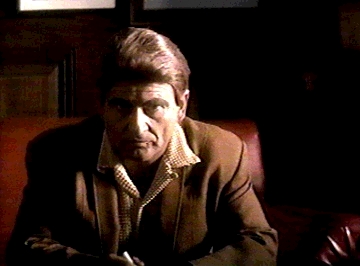
Joe Pesci as Jim Garrison's suspect, David Ferrie
Joe Pesci as Jim Garrison's suspect, David Ferrie
Based on a tip they had received, Jim Garrison's office questioned Ferrie about the trip shortly after the assassination. Here is how JFK portrays it:
As the door opens following a knock, David Ferrie is brought into Jim's office by two police officers and Lou Ivon. Jim stands up, cordial.
Ferrie suffers from alopecia, a disease that has removed all his body hair, and he looks like a Halloween character - penciled eyebrows, one higher than the other, a scruffy reddish wig pasted on askew with glue, thrift store clothing. His eyes, however, are swift and cunning, his smile warm, inviting itself, his demeanor hungry to please.LOU Chief . . . David Ferrie.
Ferrie glimpses the low-volumed TV - and images of the funeral. He looks away, jittery, and takes out a cigarette. Sharon brings the coffee in.JIM (shakes hands) Come in, Dave. Have a seat, make yourself comfortable. Coffee?
FERRIE Do you remember me, Mr. Garrison? I met you on Carondolet Street right after your election. I congratulated you, remember?
JIM How could I forget? You make quite a first impression. (on intercom) Sharon, could you please bring us some coffee? (Ferrie laughs; pause) I've heard over the years you're quite a first-rate pilot, Dave. Legend has it you can get in and out of any field, no matter how small... (Jim points to the pictures on his wall) I'm a bit of a pilot myself, you know. Flew grasshoppers for the field artillery in the war.
FERRIE Do you mind if I smoke, Mr. Garrison?
JIM (holds up his pipe) How could I? Dave, as you know, President Kennedy was assassinated on Friday. A man named Lee Harvey Oswald was arrested as a suspect and then was murdered yesterday by a man named Jack Ruby. (on each name, watching Ferrie's reaction) We've heard reports that Oswald spent the summer in New Orleans and we've been advised you knew Oswald pretty well.
FERRIE That's not true. I never met anybody named Oswald. Anybody who told you that has to be crazy.
JIM But you are aware, he served in your Civil Air Patrol unit when he was a teenager.
FERRIE No... if he did, I don't remember him. There were lots of kids in and out... y'know.
JIM (hands him a current newspaper) I'm sure you've seen this. Perhaps you knew this man under another name?
FERRIE No, I never saw him before in my life.
JIM Well that must've been mistaken information we got. Thanks for straightening it out for us. (puffs on pipe, Ferrie looks relieved; images of the funeral continue on the TV) There is one other matter that's come up, Dave. We were told you took a trip to Texas shortly after the assassination of Friday.
FERRIE Yeah, now that's true. I drove to Houston.
JIM What was so appealing about Houston?
FERRIE I hadn't been there ice skating in many years, and I had a couple of young friends with me, and we decided we wanted to go ice skating.
JIM Dave, may I ask why the urge to go ice skating in Texas happened to strike you during one of the most violent thunderstorms in recent memory?
FERRIE Oh, it was just a spur of the moment thing . . . the storm wasn't that bad.
JIM I see. And where did you drive?
FERRIE We went straight to Houston, and then Saturday night we drove to Galveston and stayed over there.
JIM Why Galveston?
FERRIE No particular reason. Just to go somewhere.
JIM And then Sunday?
FERRIE In the morning we went goose hunting. Then headed home, but I dropped the boys off to see some relatives and I stayed in Hammond.
JIM Did you bag any geese on this trip?
FERRIE I believe the boys got a couple.
JIM But the boys told us they didn't get any.FERRIE (fidgeting, lighting another cigarette) Oh yes, well, come to think of it, they're right. We got to where the geese were and there were thousands of them. But you couldn't approach them. They were a wise bunch of birds.
JIM Your young friends also told us you had no weapons in the car. Dave, isn't it a bit difficult to hunt for geese without a shotgun?
FERRIE Yes, now I remember, Mr. Garrison. I'm sorry, I got confused. We got out there near the geese and it was only then we realized we'd forgotten our shotguns. Stupid, right? So of course we didn't get any geese.
JIM I see. (stands up) Dave thank you for your time. I'm sorry it has to end inconveniently for you, but I'm going to have you detained for further questioning by the FBI.
FERRIE (shaken) Why? What's wrong?
JIM Dave, I find your story simply not believable.(2)
FERRIE Really? What part?(3)
What exactly are the facts about this car trip? Did David Ferrie really lie about it?
As depicted in JFK, information about the trip came to the DA's office from a Ferrie associate named Jack S. Martin. When the tip was called to Jim Garrison's attention in 1963, he did not know that Martin was the source. Had he known, he might well have disregarded the information, as he knew the tipster well: not only as "a liar who hates Ferrie," as Garrison would describe him three years later, but also as the crackpot who had, only months earlier, filed (and then hastily withdrawn) a frivolous lawsuit against none other than Jim Garrison, for "conspiracy to harass, molest, intimidate, and persecute" him.(4)
Martin had heard from a mutual acquaintance that Ferrie and two friends had left Louisiana by car on the evening of the assassination.(5) Because of this and other allegations Martin made about Ferrie, Garrison ordered the trip investigated thoroughly.
With the cooperation of police in Louisiana and Texas, the FBI, and even the Texas Rangers, the trip was exhaustively documented and scrutinized. Investigators talked to Ferrie and his friends, interviewed witnesses, and pored over hotel guest registers and phone records. Nothing came of it; the trip had absolutely nothing to do with the assassination.
David Ferrie
As a private investigator for New Orleans attorney G. Wray Gill, Ferrie had worked nearly every day in November 1963. Gill was representing Mob boss Carlos Marcello, whom the federal government was trying to deport. Ferrie and his friends had planned to take a few days off as soon as Marcello's deportation hearing concluded; this occurred on November 22. Ferrie spent the afternoon celebrating Marcello's court victory with others from Gill's office, then took off for the weekend with his friends.(6)
Al Beauboeuf told researcher A. J. Weberman, "The trip to Texas had been planned two weeks in advance. It all rolled out. The [Marcello] trial finished up and we just went."(7)
Why Texas? Because Ferrie and Beauboeuf wanted to visit an ice skating rink, and the closest one Ferrie knew of was in Houston.(8)
As Beauboeuf told author Gus Russo, "I was a former roller skating champion with dozens of medals. I wanted to see how good I'd do on ice. . . . We had been planning the trip for a couple of weeks."(9)
Researcher David Blackburst points out that Ferrie had recently received $7000 from employer G. Wray Gill and $1600 from a settlement with Eastern Air Lines, with which he was interested in starting a business with Beauboeuf. One of the businesses they were considering, in fact, was an ice-skating rink. "I had convinced Dave that ice skating was going to be the next big thing," Beauboeuf would later recall, "like disco became in the seventies." (Instead, they opened Dave & Al's service station two months later.)(10)
Ferrie friend Layton Martens told Gus Russo, "Ferrie had said that if [he and G. Wray Gill] won the [Marcello] case, he might be interested in purchasing a skating rink."(11)
Martens and Beauboeuf said the exact same thing in the Sixties, and each passed a polygraph (or "lie detector") examination about it in 1967.(12)
When Ferrie was questioned about his trip in November 1963, he made all of this perfectly clear. He told the FBI that "he had been considering for some time the feasibility and possibility of opening an ice skating rink in New Orleans." He "said he rented skates and skated at the rink for a while looking the situation over and also taking into consideration the amount of business at the rink. He stated that he introduced himself to [rink manager] Chuck Rolland and spoke with him at length concerning the cost of installation and operation of the rink."(13)
Among other details of the trip, Ferrie mentioned that he and his friends had also hoped to do some hunting that weekend, and had visited a goose-hunting area near Galveston, Texas.(14)
Ferrie volunteered to the New Orleans District Attorney's Office both in 1963 and later to submit to a polygraph examination and to the administration of sodium Pentothal (so-called "truth serum"). On both occasions, the DA's men turned him down.(15)
So why does Oliver Stone show Ferrie being interrogated by Jim Garrison and stumbling all over himself?
Because when Ferrie was reinterviewed by one of the DA's staffers, John Volz, in December 1966, his memory was no longer clear on the details of the trip. Most obviously, he could no longer remember whether he had taken the trip to go ice-skating or goose-hunting. Thus he had an exchange with Volz very similar to the one depicted in JFK.(16)
For example, Ferrie stated in his 1966 interview that he and his friends had taken shotguns with them for the purpose of hunting. In JFK, Stone takes Ferrie to task for this statement, pointing out that Al Beauboeuf and Melvin Coffey had both denied the three brought any weapons.
But during Ferrie's FBI interview of November 25, 1963, with the weekend's events fresh in his mind, "Ferrie stated he did not take any firearms with him when he left his home because he thought he might go out of the state of Louisiana and he did not know what the hunting seasons were in other states and he was also concerned about transporting firearms across the state line."(17)
So by utilizing a most selective sampling of the documentary evidence, Oliver Stone elevates an innocent weekend car trip into Jim Garrison's "thread that unraveled" the John F. Kennedy assassination.
Copyright © 2001, 2012 by David Reitzes
You may wish to see . . .
The JFK 100: Who Was David Ferrie?
NOTES:1. James Phelan, "Rush to Judgment in New Orleans," The Saturday Evening Post, May 6, 1967.
2. Oliver Stone and Zachary Sklar, JFK: The Book of the Film (New York: Applause, 1992), pp. 21-23 All quotations are from the shooting script and may vary slightly from the finished motion picture.
In all likelihood Ferrie was telling the truth when he denied knowing Lee Harvey Oswald, even though the two had crossed paths on at least one occasion in 1955, when Oswald was a teenager. No credible evidence links Ferrie to Oswald in 1963; it was Jack S. Martin ("a liar who hates Ferrie," as Jim Garrison once called him) who invented the story that Ferrie and Oswald were assassination conspirators. After Ferrie had died and could no longer defend himself, the tale that Ferrie associated with Oswald in 1963 was picked up by such discredited witnesses as Perry Raymond Russo and the individuals from Clinton, Louisiana. Such witnesses would later convince the House Select Committee studying the assassination (HSCA) that Oswald and Ferrie may have been associates. In retrospect, it seems clear that this was due to the desire of Mob-thirsty Committee Chief Counsel G. Robert Blakey to link Oswald to the ostensibly Mob-connected Ferrie. (In reality, Ferrie only worked as an investigator for Mob boss Carlos Marcello's attorney, G. Wray Gill.)
3. JFK, Special Edition Director's Cut, DVD. The scene would have seemed woefully incomplete without quoting this memorable line, which is not in the shooting script.
4. Patricia Lambert, False Witness (New York: M. Evans and Co., 1998), pp. 26, 294 fn. 9. Further information on the Martin-Garrison lawsuit (filed June 11, 1963; withdrawn June 14, 1963) comes from researcher David Blackburst.
5. FBI Interview of Jack S. Martin, Warren Commission Document No. 75, p. 309.
6. Patricia Lambert, False Witness (New York: M. Evans and Co., 1998), p. 26. See also researcher David Blackburst's detailed account of the episode.
7. Gus Russo, Live by the Sword (Baltimore: Bancroft Press, 1998), p. 329.
8. See researcher David Blackburst's detailed account of the episode.
9. Gus Russo, Live by the Sword (Baltimore: Bancroft Press, 1998), p. 329.
10. Gus Russo, Live by the Sword (Baltimore: Bancroft Press, 1998), p. 329.
11. Gus Russo, Live by the Sword (Baltimore: Bancroft Press, 1998), p. 329.
12. FBI Interview of David Ferrie, November 25, 1963, Warren Commission Document 75, pp. 285-97. Note: While this author questions the reliability of polygraph tests in exposing deception, the willingness of a subject to submit to a polygraph examination might be considered by some to be contrary to a consciousness of guilt on his or her part.
13. FBI Interview of David Ferrie, November 25, 1963, Warren Commission Document 75, pp. 285-97.
14. A. J. Weberman Web site. Weberman's website has changed a bit since I posted this article; click here for the current version.
15. See researcher David Blackburst's detailed account of the episode. Note: While this author questions the reliability of polygraph tests in exposing deception, the willingness of a subject to submit to a polygraph examination might be considered by some to be contrary to a consciousness of guilt on his or her part.
16. FBI interview of David Ferrie, November 25, 1963, Warren Commission Document 75, pp. 285-97; Patricia Lambert, False Witness (New York: M. Evans and Co., 1998), p. 44.
17. NODA interview with David Ferrie, December 16, 1966.
18. FBI Interview of David Ferrie, November 25, 1963, Warren Commission Document 75, pp. 285-97.
The JFK 100: Who Was David Ferrie?