The JFK 100
The Sixth Shot

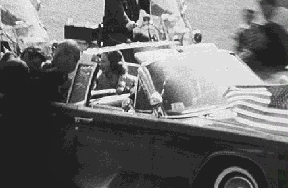
A shot misses the limousine
A shot misses the limousine
New Orleans District Attorney Jim Garrison (Kevin Costner) tells the jury that bystander "James Tague down at the underpass is hit sometime now by another shot that misses" the President's limousine. The shot originates in the Dal-Tex Building, says the DA, located behind the limo, across the street from the Texas School Book Depository.(1)
As noted in The JFK 100: The First Shot, not a single eyewitness reported any shots coming from the Dal-Tex Building. Moreover, it is not clear why Stone would postulate this shot, as this is the second shot his purported Dal-Tex gunman has missed. (And people say Oswald was a poor marksman.) If indeed the bullet or bullet fragment that struck near James Tague was the result of a missed shot from the Dal-Tex Building, Stone is postulating one more shot than necessary, and one without any evidence to support its existence.
However, as discussed in The JFK 100: Eyewitness James Tague, the missile that struck near Tague could be either a missed shot or a fragment of the bullet that fatally struck the President in the head.
Nevertheless, based on the physical and photographic evidence, as well as eyewitness testimony, it is almost universally believed that at least one shot missed the limousine. Researchers debate the timing of this missed shot, but a growing concensus places it at approximately frame 155 of the film taken by bystander Abraham Zapruder.(2)
Here, then, is a quick review of some of the evidence for a missed shot circa frames 155-157 in the Zapruder film.
Around Zapruder frame 160-165, ten-year-old Rosemary Willis, who has been running on the grass alongside the President's limousine, begins to slow down; by frame 190 she has come to a complete halt. "I stopped when I heard the shot," she says.(3) "In that first split second, I thought it was a firecracker. But within maybe one-tenth of a second, I knew it was a gun shot."(4)
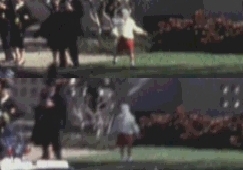
In Z frame 177 (top), Rosemary Willis is breaking stride.
By frame 190 (bottom), she is standing still.

Rosemary Willis comes to a halt in this stablized, animated GIF by Gerda Dunckel
Numerous investigators and authors from a variety of perspectives on the case, including analysts for the House Select Committee investigating the Kennedy assassination during the late 1970s; and experts commissioned by the Failure Analysis Associates corporation; lone-assassin-oriented authors Gerald Posner, Dale Myers, and Richard Trask; and conspiracy-oriented researchers Robert Groden and Michael Griffith; have all noted that Governor John Connally's head turns sharply to the right around Zapruder frames 161-162. Trask writes, "Between Z 162 and 167, the Governor suddenly jerks his head to the right." (See animated image below.)(5)
Trask continues, "Governor Connally now appears to move his body right following his head movement, possibly attempting to look at the President." (6)This, of course, is consistent with Connally's Warren Commission testimony of his actions following the first shot:
We had just made the turn, well, when I heard what I thought was a shot. I heard this noise which I immediately took to be a rifle shot. I instinctively turned to my right because the sound appeared to come from over my right shoulder, so I turned to look back over my right shoulder, and I saw nothing unusual except just people in the crowd, but I did not catch the President in the corner of my eye, and I was interested, because once I heard the shot in my own mind I identified it as a rifle shot, and I immediately -- the only thought that crossed my mind was that this is an assassination attempt.(7)In 1979, the House Select Committee on Assassination's Photographic Panel wrote:
The first reaction by any of the limousine occupants to a severe external stimulus begins to occur in the vicinity of Zapruder frames 162-167. At this time, Connally is looking to his left, when his head begins a rapid, sudden motion to the right. In quantitative terms, he turns his head approximately 60 degrees to his right in one-ninth of a second (a rate equivalent to a 540-degree rotation per second). He pauses momentarily and then executes a further 30-degree turn to his right, within an eighteenth of a second (again, a rate equivalent to a 540-degree rotation per second). This initial rapid motion, in which Connally has apparently turned his head to look behind him, is accompanied during the next approximately 20 frames by a more gradual 60-degree shift to the right of his upper torso. Although it is apparent that none of the limousine occupants has been shot at the time that Connally initiates this movement, the Panel considers these actions to be particularly significant because they were consistent with his Warren Commission testimony that he turned in response to having heard the first shot and was struck almost immediately afterwards.(8)Of the Zapruder frame sequence 155-157, researcher Dale Myers writes, "This is the first occurrence of movement that suggests a shot has been fired. Both JFK and JBC [Governor Connally] turn sharply to their right immediately after frame 157."(9)
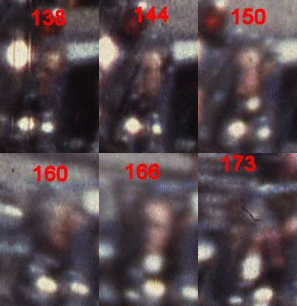
Governor Connally in Zapruder frames 138-173
Animated image courtesy of researcher Vincent Van

JFK in Zapruder frames 138-162
Animated image courtesy of researcher Vincent Van
"Although JFK may be reacting to the passing crowd," Myers continues, "JBC's movements match his testimony concerning the first shot." "Connally's sharp turn to the right after Z 157 is the only such turn preceding his own wounding a few seconds later. This is also consistent with his testimony. Zapruder frame 157 was selected as the likely time of this first shot based on Connally's reaction a quarter-second later. Since this first shot apparently missed, the exact frame is unknown."(10)
An independent 1993 investigation by Failure Associates Analysis confirmed these conclusions.(11)
The House Select Committee's expert Photographic Evidence Panel's analysis of the Zapruder film placed a possible shot "at frames 158-160," based upon the blurring of the film at this point. "The most interesting thing about this hypothetical shot," the panel writes, "is that Mrs. Kennedy and Governor Connally testified before the Warren Commission and Governor Connally testified before the [House] select committee that they turned to their right when they heard the first shot, and both are seen in the film beginning a turn to the right immediately after this hypothetical shot. This appears particularly striking in the case of Governor Connally, whose head turns from mid-left to far right in less than half a second, beginning at frame 162."(12)
Photographic evidence, then, indicates that three eyewitnesses -- John F. Kennedy, Governor John B. Connally, and ten-year-old Rosemary Willis -- each made a distinct, quantifiable physical movement at precisely the same instant, apparently in response to an external stimulus -- such as a gun shot.
Governor Connally testified consistently that he turned to his right when he heard the first shot, which is exactly what the Zapruder film indicates. Asked why she stopped running, Rosemary Willis stated, "I stopped when I heard the shot."
So there is considerable evidence that a shot missed the limousine at that time. But there is no evidence that it (or any shot) came from the Dal-Tex Building, as Oliver Stone claims, and no evidence that a missed shot was responsible for the strike near James Tague, down by the Triple Underpass.
NOTES:1. Oliver Stone and Zachary Sklar, JFK: The Book of the Film (New York: Applause, 1992), p. 165. All quotations are from the shooting script and may vary slightly from the finished motion picture.
2. Journalist Max Holland and Johann Rush (who, as cameraman for WDSU-TV in New Orleans back in the summer of 1963, filmed Lee Harvey Oswald distributing pro-Castro leaflets) have proposed that the missed shot was fired approximately two seconds earlier, at a time when Zapruder was not filming. (Max Holland and Johann Rush, "J.F.K.’s Death, Re-Framed," New York Times, November 22, 2007.) Researcher Kenneth Scearce has posted an article in support of this idea. While this hypothesis is hardly outrageous, as some critics have claimed, it is not well supported by the evidence.
3. David Lui, "The Little Girl Must Have Heard," Dallas Time-Herald, June 3, 1979, cited in Gerald Posner, Case Closed (New York: Random House, 1993), p. 321.
4. Marcia Smith-Durk interview with Rosemary Willis, 1979, cited in Posner, p. 321.
5. Robert J. Groden, The Killing of a President (New York: Viking, 1993), p. 21. Posner, p. 322. Richard Trask, Pictures of the Pain (Danvers, Mass.: Yeoman, 1994), p. 64. Michael T. Griffith: "Reactions to Six Shots in the Zapruder Film," 1998. Dale Myers, Secrets of a Homicide, 1998.
6. Richard Trask, Pictures of the Pain (Danvers, Mass.: Yeoman, 1994), p. 64.
7. Warren Commission Hearings, Vol. IV, pp. 132-33.
8. Hearings before the Subcommittee on the Assassination of John F. Kennedy of the Select Committee on Assassinations, House of Representatives, Vol. VI, p. 17.
9. Dale Myers, Secrets of a Homicide, 1998.
10. Dale Myers, Secrets of a Homicide, 1998. Prominent researchers Max Holland and Johann Rush have suggested that the shot was fired an instant earlier than Myers proposes. This theory has proved controversial, however; it is supported in this article by Kenneth R. Scearce, but rejected by Dale Myers and Todd W. Vaughan.
11. Exponent (formerly Failure Analysis Associates), JFK Assassination Mock Trial.
12. Hearings before the Subcommittee on the Assassination of John F. Kennedy of the Select Committee on Assassinations, House of Representatives, Vol. VI, p. 29, cited in Posner, pp. 322-23.